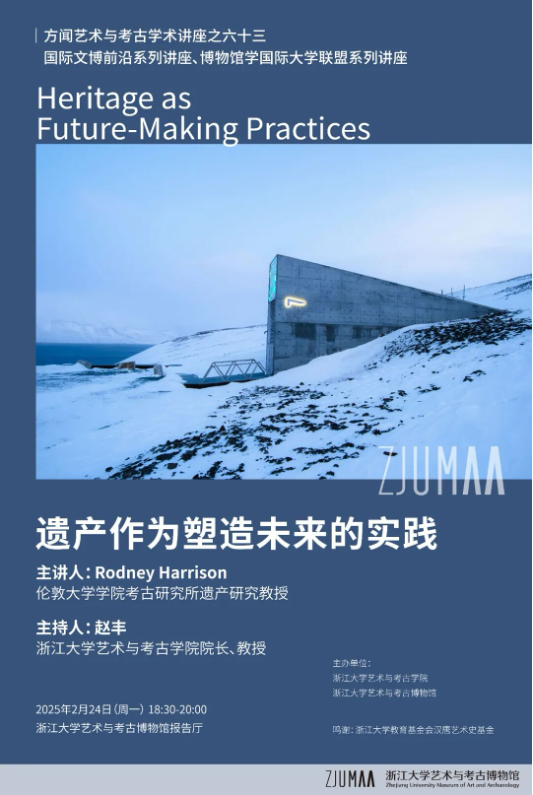
Lecture Synopsis:
We often hear that preserving natural or cultural heritage is for future generations or aims to conserve resources for posterity. But what does this really mean upon closer examination? What kind of future do such statements envision, and who exactly are these future generations destined to inherit these legacies?
This lecture introduces a major international and interdisciplinary research project that compares and explores how various heritage preservation practices shape the future. Case studies include efforts to safeguard endangered languages, species conservation and landscape rewilding, cryopreservation of endangered plant and animal DNA, botanical gardens, museums, and the protection of historic buildings and landscapes.
By analyzing and comparing work from over 25 regional, national, and international governmental and non-governmental organizations across more than ten countries, the project concludes that the capacity of different heritage practices to shape the future can only be realized through the integrated management of diverse forms of heritage. Moreover, these capacities emerge when heritage preservation is regarded as an aspect of sustainable development—that is, when heritage serves ongoing social processes rather than being isolated from public engagement.
The project also highlights that future heritage practitioners must not only focus on preservation but also develop strategies to mitigate—and help the public better understand—processes of adaptation, reuse, change, transformation, and even loss affecting natural and cultural heritage. These challenges become especially urgent in the context of the climate crisis.
Speaker Profile:
Rodney Harrison is Professor of Heritage Studies at the UCL Institute of Archaeology. He also serves as the Arts and Humanities Research Council (AHRC) Heritage Priority Area Leadership Fellow, and is the Principal Investigator of the AHRC-funded Heritage Futures Research Programme. He leads the work on Theorizing Heritage Futures for Europe: Heritage Scenarios within the doctoral training network CHEurope (Critical Heritage Studies and the Future of Europe).
He is the founding editor of the Journal of Contemporary Archaeology and co-director of the UCL-University of Gothenburg Centre for Critical Heritage Studies. He has authored, co-authored, edited, or co-edited more than 20 books, and has published over 100 journal articles and book chapters, some of which have been translated into Chinese, Italian, Polish, and Portuguese.
His current research projects include:
• Reimagining Museums for Climate Action
• Landscape Futures and the Challenge of Change: Towards Integrated Cultural/Natural Heritage Decision Making
• Ghosts of Solid Air
• Black Atlantic Innovation Network