

About the Laboratory
The Art and Archaeology Image Data Laboratory at Zhejiang University was named among the first group of Philosophy and Social Sciences Laboratories designated by China’s Ministry of Education in November 2021, and was selected as a provincial pilot laboratory in the same field in December 2024. It has a research team of 124, including 120 full-time and 4 affiliated researchers, among them 27 professors, 40 doctoral supervisors, and 4 recipients of national early-career talent awards.
The Laboratory studies the image data of art and archaeology. Building on major undertakings such as A Comprehensive Collection of Ancient Chinese Paintings, the digitization of cave-temple heritage, and the archaeology of early civilization in the lower Yangtze, it draws together art history, archaeology, design, computer science, data science, and intelligent science. Its research supports the creation of a large-scale image resource documenting China’s artistic and archaeological heritage.
Research Directions
Image big data — theories and methods for large-scale image data in art and archaeology.
Digital preservation — technologies and applications for the digital preservation of cultural heritage.
Archaeological science — image-based theories and methods for scientific archaeology.
Key Achievements and Representative Projects
In recent years the Laboratory has published more than 100 high-level research papers, completed 11 books, and filed over 20 patents and more than 30 software copyrights. It has led 5 major and key national research projects and more than 50 major commissioned projects, and has received 8 provincial-, ministerial-, or higher-level awards for research and teaching.
1. Innovative Design for A Comprehensive Collection of Ancient Chinese Paintings
The Laboratory’s design-led data-visualization team works on knowledge-graph construction for the Collection, with the framework now at its concluding review stage. It has made notable progress in ontology construction, color-network analysis, and color restoration, as well as in AI-assisted authentication of ancient paintings using large language models and knowledge graphs. By drawing on the semantic understanding and task-decomposition abilities of large models, the team has proposed an expert-led, AI-assisted approach to the study of ancient Chinese painting. It has supported the virtual color restoration of nearly 100 Tang- and Song-dynasty paintings and integrated this work into teaching at the intersection of design and artificial intelligence.
Over the past five years the team has published nearly 50 papers in venues including npj Heritage Science (a Nature-family journal), IEEE Transactions on Visualization and Computer Graphics (IEEE TVCG), and leading Chinese journals such as Zhuangshi and the Journal of Zhejiang University (Humanities and Social Sciences). It has filed 15 patents (7 granted) and 5 software copyrights, published 3 monographs, and helped train one national and one provincial young talent. In 2025 it added a national major social science project, two provincial major projects, and a National Arts Fund project.
On 19 October 2025, the International Symposium on A Comprehensive Collection of Ancient Chinese Paintings was held at the China National Archives of Publications and Culture in Hangzhou. The Laboratory organized a dedicated forum on the transmission and innovation of ancient painting in the digital age, examining how data and intelligent technologies can support the understanding and creation of traditional Chinese painting.
2. “Zhihua”: A Foundation Model for Traditional Chinese Painting
Led by the Laboratory, “Zhihua” (知画) is a multimodal foundation model that applies large-model technology to the digital preservation and creative use of traditional Chinese painting. Built on artificial intelligence and big-data technologies, the platform serves both the academic needs of art and archaeology researchers and the wider public’s interest in appreciating and learning about painting. It combines computer vision with traditional theories of Chinese painting to interpret classic works and to build an image-language system with both scholarly depth and technical capability.
The platform incorporates several technical advances: a scalable, high-availability distributed architecture for the secure, real-time access of multimodal art and archaeology data; a high-performance search engine offering millisecond, full-collection retrieval with exact, fuzzy, wildcard, field-specific, and Boolean queries; and content-analysis features including image-to-image search, similar-image recommendation, and large-model-driven image segmentation for the semantic and structural analysis of complex images.
Its architecture comprises four core sub-platforms: an annotation platform for expert labeling; an appreciation platform for the general public; an analysis platform for professional research and image analysis; and a back-end platform for data management and operations.
3. High-Fidelity Digitization Technology for Cultural Heritage
To meet the high-fidelity demands of heritage digitization, the Laboratory has independently developed a suite of acquisition equipment that fills gaps in the field: automated high-fidelity capture systems for murals; portable high-fidelity scanners for silk, painting, and calligraphy; photometric-stereo 3D scanners for highly reflective objects; and large dynamic 3D scene scanners for fine archaeological excavation and conservation records. It has also developed supporting software, including representative-color-based color correction, fine 3D reconstruction from very large photo sets, automatic texture mapping, and automatic mural stitching.
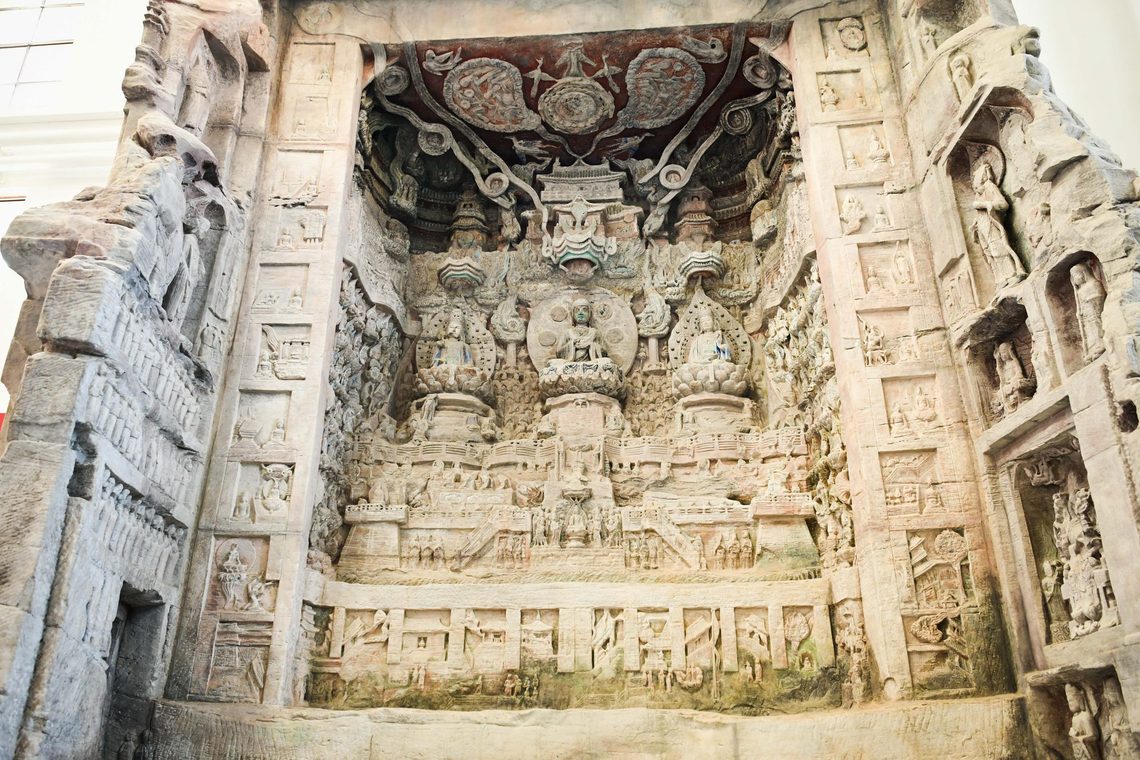
Building a complete solution for the 3D-printed replication of cultural relics, the Laboratory achieved—for the first time worldwide—a full-scale replica of Cave 3 of the Yungang Grottoes and a movable, assemblable exhibition replica of Cave 12. Its results have been applied at more than 100 heritage institutions and archaeological sites across the country, supporting over 200 digitization projects for national-treasure-level relics and preserving more than 500 TB of complete, systematic, and scientific digital archives.
Contact
Address: Art and Archaeology Image Data Laboratory, Zhejiang University, 148 Tianmushan Road, Hangzhou, Zhejiang 310028, China
Phone: +86-571-8827-3332
Email: zjuaailab@zju.edu.cn
Contacts: Ms. Li and Ms. Zhang